Note that this research is a still a working draft and subject to change.
1 Introduction
Understanding what services exist, where they are, and the barriers to their use is important information to organizations and authorities providing support to displaced communities. Understanding how far away the service is, and how long it takes to travel there is part of this.
Travel time to services indicators are commonly seen in humanitarian assessments, such as the Multi-Sectoral Location Assessments (MSLA) by IOM’s DTM, in household Multi-Sectoral Needs Assessments (MSNAs) and were a feature of the core indicator library in the first version of the Joint Interagency Analysis Framework (JIAF).1
While important, it should be noted that travel time alone is not sufficient to fully understand access service access in an area. Factors such as appropriateness, affordability, quality and accessibility play a big role in fully understanding the barriers to service.
In the past, humanitarian actors have relied on key-informant and household surveys to answer questions on travel time to service. However, improvements in data availability, primarily road network data from OpenStreet Map, facility data from OSM, Healthsites.io and WHO’s HERAMS, and computational tools such as OSMNX have opened up new possibilities for measuring travel time.
This paper explores these methods and proposes how to apply them to improve crisis decision-making, using Mozambique as a case-study. The work here is a continuation of an initial pilot conducted by Manon Jones and Brian Mc Donald as part of IOM’s Camp Coordination and Camp Management unit.
2 Objectives
The objectives of this paper are four-fold:
To compare service travel time estimates gathered though key-informant interviews, against travel time estimates derived from computational approaches.
To utilize computational approaches to validate or triangulate key-informant travel time data, to improve data collection process.
To identify priority locations to investigate barriers other than travel time.
And finally, to develop a tool than can be incorporated into existing data collection systems to improve data quality and provide additional analytical insight for humanitarian actors.
3 Methodology
The steps of this analysis focus specifically in the example of Mozambique and are as follows:
Gathering the required data - street network data from Open Street Maps; Internally Displaced Population (IDP) data from IOM’s DTM that includes location information, IDP counts and health facility travel time estimates; health facility location data from Healthsites.io (Open Street Map) or WHO’s HERAMS; and optionally, Digital Elevation Model (DEM) data to better inform travel speed and time estimates.2
Using the above data to identify the nearest heath facility to each IDP sites.
Calculate the route between each site and its closest health facility, along with the routes distance and travel time estimates.
Compare computed travel times across both the key informant responses and the computed times to identify patterns.
4 Analysis
We chose a individual site to illustrate the analytical steps involved in the process. Mandruzi was chosen due to it’s proximity to Beira, close to a large town - an area with with significant road networks mapped on OSM and with a number of health facilities in close proximity to the IDP site, in which to test the approach.
4.1 Mandruzi IDP site
Mandruzi IDP site is situated on the south-west edge of Dondo, a small town 35 km northwest of Beira.
According to the data from OSM, there are 5 health facilities in the Dondo area: Centro de Saude de Macharote, Centre de Saude de Dondo, Centro de Saude de Lusalite, Centro de Saude de Nhaimanga and Centro de Saude de Canhandula.
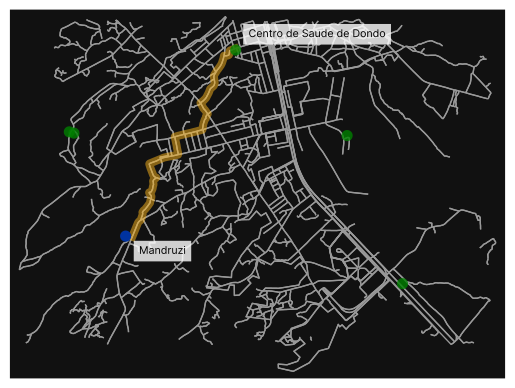
Using OSMNX, we calculate that the closest health facility to Mandruzi is Centro de Saude de Dondo, 4,049 metres distance or an estimated 49 minutes walk north of the site. From the map, we see that in the case of Mandruzi, it is a similar distance, albeit slightly further to both Macharote and Lusalite.
4.2 All IDP sites
Expanding this approach to all IDP sites, we can see in the map below, all IDP sites, all health facilities and the routes between each IDP site and its closest health facility.
4.3 Distribution of travel times
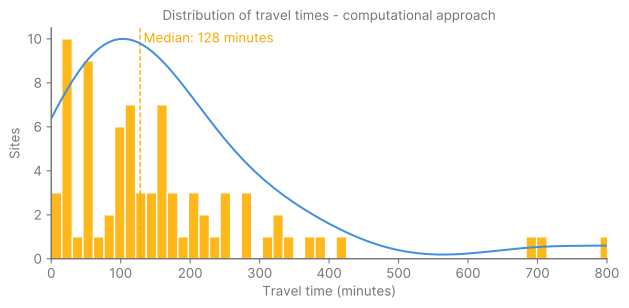
The following chart shows the distribution of computed travel times from all 80 IDP sites, in segments of 15 minutes.
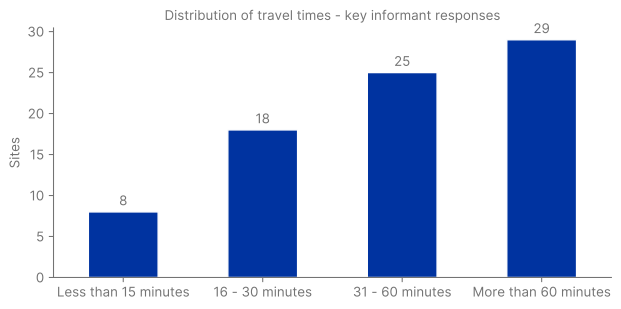
The following chart shows the distribution of travel time answers from the key informant responses. The segments in this case are the 4 response options available for the question .
Comparison against KI responses
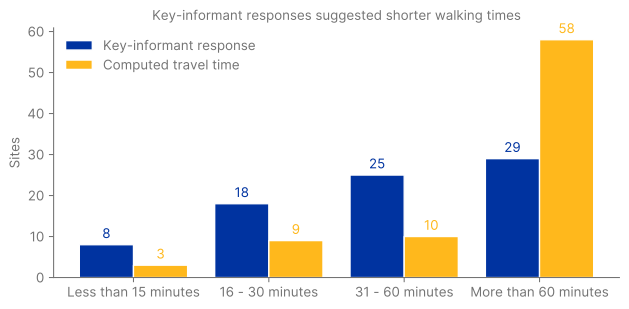
Only 34 (43%) of the 80 sites had computed travel times that matched the ranges provided by the key informants.
4.4 Patterns of variance
Quality Control
Public site assessment data sources don’t contain personal information of enumerators or unique identifiers that would allow us to check if travel time responses gathered by some enumerators tend to have a higher rate of mismatches to computed time, compared to other enumerators. The raw collected data however would feature this data and allow field teams to explore any correlation and address the causes such as enumerator training or performance
Spatial patterns
In this instance we see two significant clusters of sites where the KI and computed times do not match, one near Quilimane and another to the west of Guara-Guara. This this provides us with priority areas in which to further explore the reasons behind the mismatches and the barriers to access. From a data perspective, these spatial clusters of mismatches may be as a result of missing health facility data. The availability of such data in OSM can vary significantly from one area to the next. Areas prioritized for mapping through the HOT OSM Tasking Manager for instance tend to have higher coverage, while other areas maybe see far less of their health facilities mapped.
Other access factors, not related to travel time can also play a significant role in these mismatches, for example in areas with conflict of inter communal tensions, certain facilities, while closer, may not be seen as safe to access, appropriate for the displaced community or even affordable to use. This tool can provide a triage and targeting function to guide efforts to better understand the barriers.
5 Findings
The use of computational approaches alongside key informant approaches can improve the quality of travel time to services data. It can also provide a solid base in which to target areas to better understand barriers to access that are beyond basic physical travel time.
When including questions on travel time to a service in questionnaires, the question should ask for a specific figure (in minutes with the inclusion of mode of travel, or distance) instead of pre configured ranges such as what was shown in the above dataset. The reason for this is to provide more accurate data, reducing bias, while still allowing for the data to be converted in to ranges at a later date. Two illustrations of this are:
where travel time to a health facility for a number of sites is approximately 15-16 minutes, these sites, despite similar travel times, will fall into different categories. If these categories are used as criteria for targeting interventions, this minuscule difference may result in a disproportionately large difference in terms of response.
for elderly people or those with physical disabilities, the difference in approximated travel time of 1 and 15 minutes can be significant and can determine whether or not the person can actually use the service. Asking the question as ranges as opposed to distinct value limits its use in such cases due to the limited granularity of the response.
6 Limitations & next steps
The computational approach relies on having good quality and complete road and path network data. Sparse or inconsistent levels of road network can undermine or skew the analysis. Another network issue is that in many places walking to services is not done along recognizable roads or pathways but through open areas. In these cases, the approaches dependency on network data is a limiting factor of the analysis.
While initiatives like OSM, Healthsites.io and HERAMS have greatly improved the quantity and quality of health facility data, for many countries and even within countries, the available data in insufficient to support meaningful analysis. In addition to this, the computational approach may be of limited use in dynamic contexts such as disaster response, where the relatively static facilities data is not able to respond to local dynamics where facilities may close or become temporarily in operational. To help address this shortcoming, the required datasets should be linked to API driven systems to ensure that the most recent datasets for a given area are used rather than older static dataset that are not updated. Continued investments in initiatives such as OSM and HERAMS are also important.
An underlying assumption of this approach is use of static facilities as a proxy for service delivery points. Looking at facilities as the sole points of service delivery can significantly under represent services, as we can see from Figure 6. Many services are provided through mobile modalities. To better address this gap, additional data sources for mobile service delivery should be incorporated into the analysis.
The above analysis uses a fixed walking speed for the travel time calculations. This does not incorporate speed variations due to elevation inclines or other factors such as road surface. The OSMNX tool can be configured to incorporate elevation data and we hope to use it in future versions of the analysis.
Finally, a benefit of this computational approach, is that it can be incorporated into humanitarian organizations systems and tools, taking advantage of the increased use of APIs, to produce scalable and semi automated products.